

How Much Does a Podcast with 10,000 Listeners Make?
Estimate how much a podcast with 10,000 listeners can make from sponsorships, YouTube, subscriptions, affiliates, services, and products.
Last updated May 25, 2026. Comparison guidance is current as of 2026.

Summary
A podcast with 10,000 listeners per episode might make anywhere from $0 to several thousand dollars per month depending on niche, listener trust, ad inventory, publishing frequency, and monetization model. Downloads alone do not determine revenue.
For sponsorships, a rough benchmark is often based on CPM, or cost per thousand impressions. At 10,000 listens, one ad slot at a $20 to $50 CPM could generate about $200 to $500 per episode before network fees or unsold inventory. Direct sponsorships, paid communities, consulting, courses, affiliates, and YouTube can change the number significantly.
Use this with pricing, podcast content repurposing, and AI Shorts Maker when comparing revenue against production cost. For platform monetization, review Spotify's Partner Program announcement and YouTube's podcast guidance.
Table of contents
- Quick answers
- Sponsorship Revenue Estimate
- Why Listener Value Matters More Than Size
- Other Revenue Streams
- Production Cost Reality Check
- How to Improve Revenue per Episode
- Znippet POV
- FAQ
Quick answers
- Can 10,000 listeners make money? Yes, but revenue depends on audience fit, niche, trust, and monetization method.
- Simple sponsorship estimate: About $200 to $500 per ad slot at a $20 to $50 CPM.
- Can it make more? Yes, especially with high-value B2B audiences, direct sponsors, products, services, or subscriptions.
- Can it make nothing? Also yes, if the show has no sales process, weak audience fit, or no monetization strategy.
Sponsorship Revenue Estimate
The basic sponsorship formula is:
Revenue = downloads divided by 1,000, multiplied by CPM, multiplied by number of ad slots.
For 10,000 listens:
- $20 CPM x 10 = $200 per ad slot.
- $35 CPM x 10 = $350 per ad slot.
- $50 CPM x 10 = $500 per ad slot.
If you publish four episodes per month and sell one ad slot in each episode, that is roughly $800 to $2,000 per month before fees. Two sold ad slots could double that, but only if the ads fit the show and do not hurt listener trust.
These are directional estimates, not guaranteed rates. Some shows earn less because inventory is unsold. Some earn more because the audience is valuable to a specific sponsor.
Why Listener Value Matters More Than Size
A podcast with 10,000 general entertainment listeners may earn less than a podcast with 3,000 highly targeted business buyers. Advertisers pay for relevant attention, not only raw downloads.
Revenue improves when:
- The audience has a clear identity.
- The niche has buyers.
- The host has trust.
- Sponsors can measure outcomes.
- The show publishes consistently.
- The episode archive keeps attracting listeners.
If your show creates video or social clips, it may also generate extra reach outside the RSS feed. The podcast-to-social workflow can help extend the value of every recording.
Other Revenue Streams
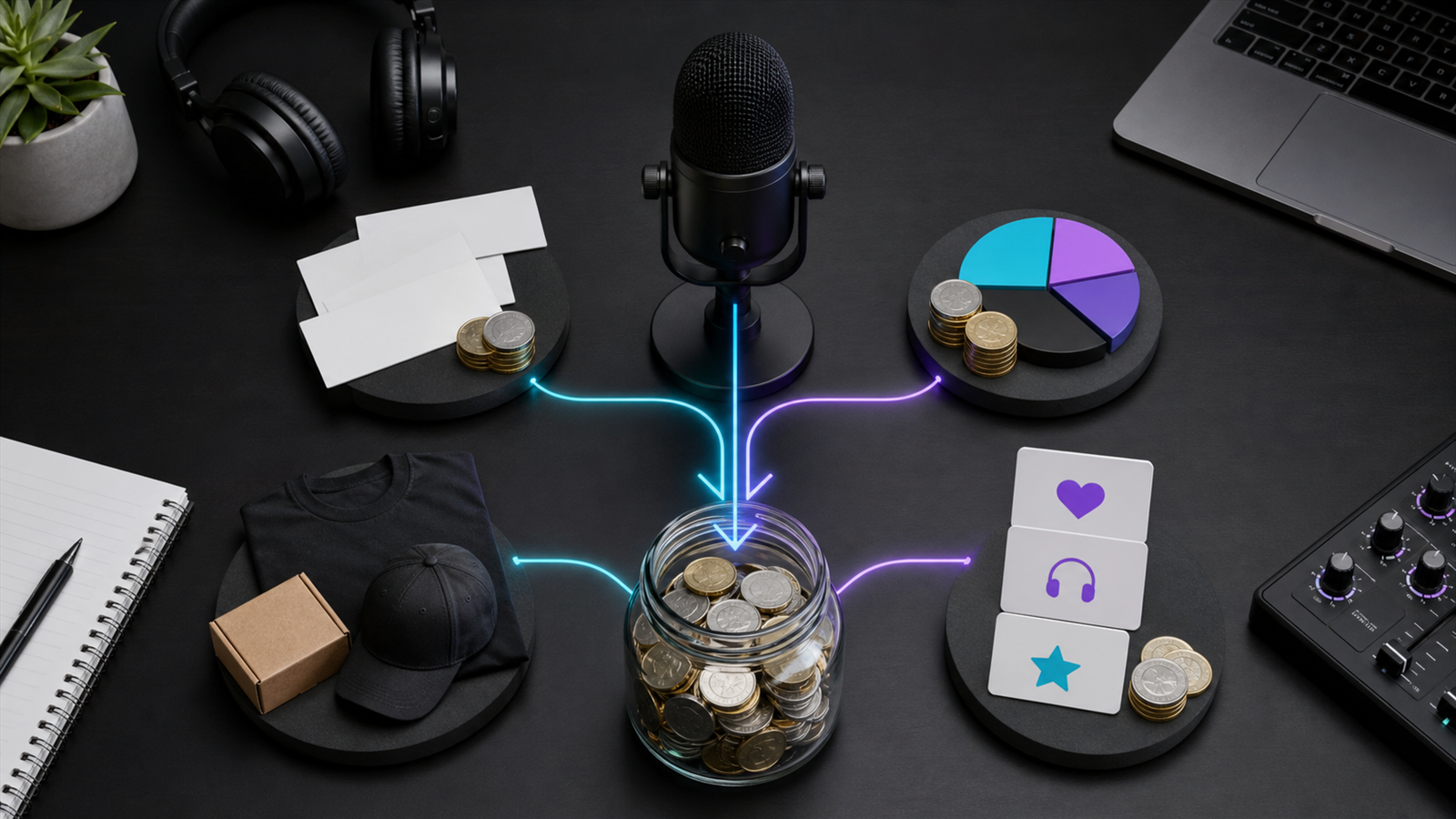
Sponsorship is only one model. A 10,000-listener podcast may monetize through:
- Host-read ads.
- Affiliate links.
- Paid subscriptions.
- Courses or digital products.
- Consulting or services.
- Events.
- YouTube monetization.
- Brand partnerships.
Spotify announced expanded creator monetization through the Spotify Partner Program in supported markets. YouTube podcast publishing may also matter if the show has a video strategy; review YouTube's podcast documentation for setup context.
Production Cost Reality Check
Revenue is only useful after production costs. A weekly podcast may spend money on editing, hosting, design, clips, transcripts, booking, and producer support.
Compare monthly revenue against:
- Editing costs.
- Producer fees.
- Clip creation.
- Software and hosting.
- Guest booking.
- Paid promotion.
- Internal team time.
If the show makes $1,500 per month but costs $2,500 to produce, it may still be worth running for brand, pipeline, or community reasons. But the financial model should be explicit. Use pricing and podcaster workflows to compare manual production against automated repurposing support.
How to Improve Revenue per Episode
To increase earnings from 10,000 listeners, improve the value of each episode instead of chasing downloads alone.
Practical steps:
- Build a sponsor page with audience details.
- Track listener demographics and outcomes.
- Package episodes with clips and newsletter placements.
- Sell direct sponsorships where possible.
- Use affiliate offers only when they fit the audience.
- Turn strong episodes into blog posts and short-form clips.
- Create owned products or services around the show's expertise.
The content repurposing workflow helps make each recording produce more assets without requiring a new idea for every channel.
Znippet POV
Our view is that 10,000 listeners is enough to take the business side seriously, but not enough to get careless with production cost. The smartest shows use each recording as a content asset, not only an audio file. A strong episode can support clips, newsletters, sales follow-up, blog content, and sponsor proof.
That does not mean every clip should be published. It means the show should have a repeatable way to find the few moments that preserve context and help the right audience take the next step.
FAQ
How much can a podcast with 10,000 downloads make from ads?
A rough estimate is $200 to $500 per ad slot per episode at a $20 to $50 CPM. Actual revenue depends on niche, sales method, fill rate, and advertiser demand.
Is 10,000 listeners a lot for a podcast?
Yes, for many independent shows it is meaningful. But revenue depends more on audience quality, trust, and monetization than listener count alone.
Can a smaller podcast make more money?
Yes. A smaller show in a valuable niche can make more through direct sponsors, consulting, products, or affiliate offers than a larger but less targeted show.
Sources and further reading
Background links used to check product details, terminology, and practical context.
- Apple Podcasts requirements
Apple Podcasts for Creators
Used as background context for product details, platform requirements, or workflow comparison.
- Create a podcast in YouTube Studio
YouTube Help
Used as background context for product details, platform requirements, or workflow comparison.
- YouTube Shorts creation guidance
YouTube Help
Used as background context for product details, platform requirements, or workflow comparison.
- Spotify Partner Program announcement
Spotify Newsroom
Used as background context for product details, platform requirements, or workflow comparison.
- Podcast measurement guidelines
Interactive Advertising Bureau
Used as background context for product details, platform requirements, or workflow comparison.
- Advertising and marketing guidance
Federal Trade Commission
Used as background context for product details, platform requirements, or workflow comparison.
- Captions and subtitles
W3C Web Accessibility Initiative
Used as background context for product details, platform requirements, or workflow comparison.
- Adobe Audition user guide
Adobe
Used as background context for product details, platform requirements, or workflow comparison.
- Riverside official website
Riverside
Used as background context for product details, platform requirements, or workflow comparison.
- Descript official website
Descript
Used as background context for product details, platform requirements, or workflow comparison.
- OpusClip official website
OpusClip
Used as background context for product details, platform requirements, or workflow comparison.
Keep comparing workflows
Related comparison guides
For podcast makers
Turn long-form footage into publishable clips
Use Znippet AI Shorts Maker to find strong moments, add readable captions, remove dead air, and export clips for Shorts, Reels, TikTok, and social channels.